Last updated: June 2026 — prices and transport verified June 2026.
I came to the Caucasus for Georgia — for the qvevri wine and Giorgi’s vineyard in Kakheti — and added Armenia almost as an afterthought. The day I did Garni and Geghard was the day I understood that Armenia was not an afterthought. The geography teacher in me wants you to know: this gorge contains 2,000 years of continuous human settlement, one of the most extraordinary surviving pagan temples in Asia, and a monastery where the acoustics are not an accident. Context matters at these places. Here’s the context.
The Three Sites: What You’re Visiting and Why
The standard Garni–Geghard day trip covers three distinct sites along the same road through the Azat River Gorge. They’re different enough that visiting all three doesn’t feel repetitive.
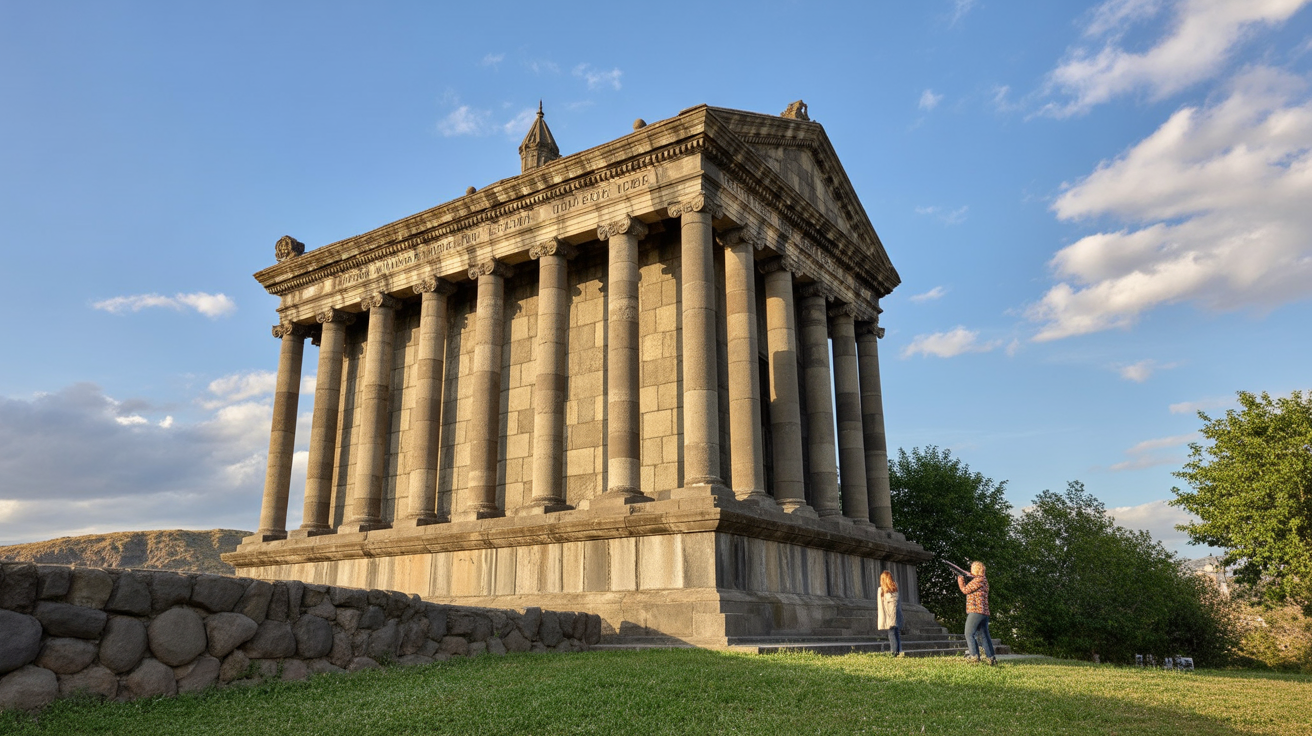
Garni Temple: A 1st-century AD Hellenistic temple on a triangular promontory above the gorge. Twenty-four columns, a peristyle design that would look at home in Greece or Rome, built by a Christian king’s predecessor to the sun god Mihr. Armenia adopted Christianity in 301 AD — the earliest nation-state to do so — and this temple survived because later kings used it as a summer house rather than demolishing it. The earthquake of 1679 destroyed it; it was reconstructed in the 1970s from original stones. The reconstruction is visible if you know what to look for, but the overall effect — temple at the edge of a basalt gorge, the mountains behind, the Azat River far below — is not diminished by knowing this.
Symphony of Stones: The basalt column formations in the Azat River Gorge between Garni and Geghard — hexagonal columns created when lava flows cooled, similar to the Giant’s Causeway in Northern Ireland. The Armenians named them the Symphony of Stones for the obvious reason: seen from the canyon overlook, the geometric columns look like a massive pipe organ. Free to view from the road. A path descends to the riverbank for a closer look — allow 20–30 minutes if you want to do this.
Geghard Monastery: The UNESCO World Heritage Site — listed as “Monastery of Geghard and the Upper Azat Valley.” Founded in the 4th century, with the current structures built in the 13th. What makes it extraordinary: the main cathedral is conventional stone construction, but the side chapels and the gavit (narthex) are carved directly into the cliff face, with vaulted ceilings and stalactite ornamentation cut from live rock. The monastery once housed the Holy Lance — the spear that pierced Christ’s side at the crucifixion — which explains the name: “geghard” means spear in Armenian. The Lance is now in the treasury of Etchmiadzin Cathedral. The monastery is active. Services happen. Visitors are welcome but this is not a museum.
Garni Temple: What to Know Before You Arrive
Open daily 9am–7pm in summer, shorter hours in winter. Entry: 1,500 AMD (~£2.85 / ~$3.75) for foreign visitors. There is a two-tier pricing system — the local Armenian price is lower. This is standard for Armenian heritage sites and not worth arguing about.
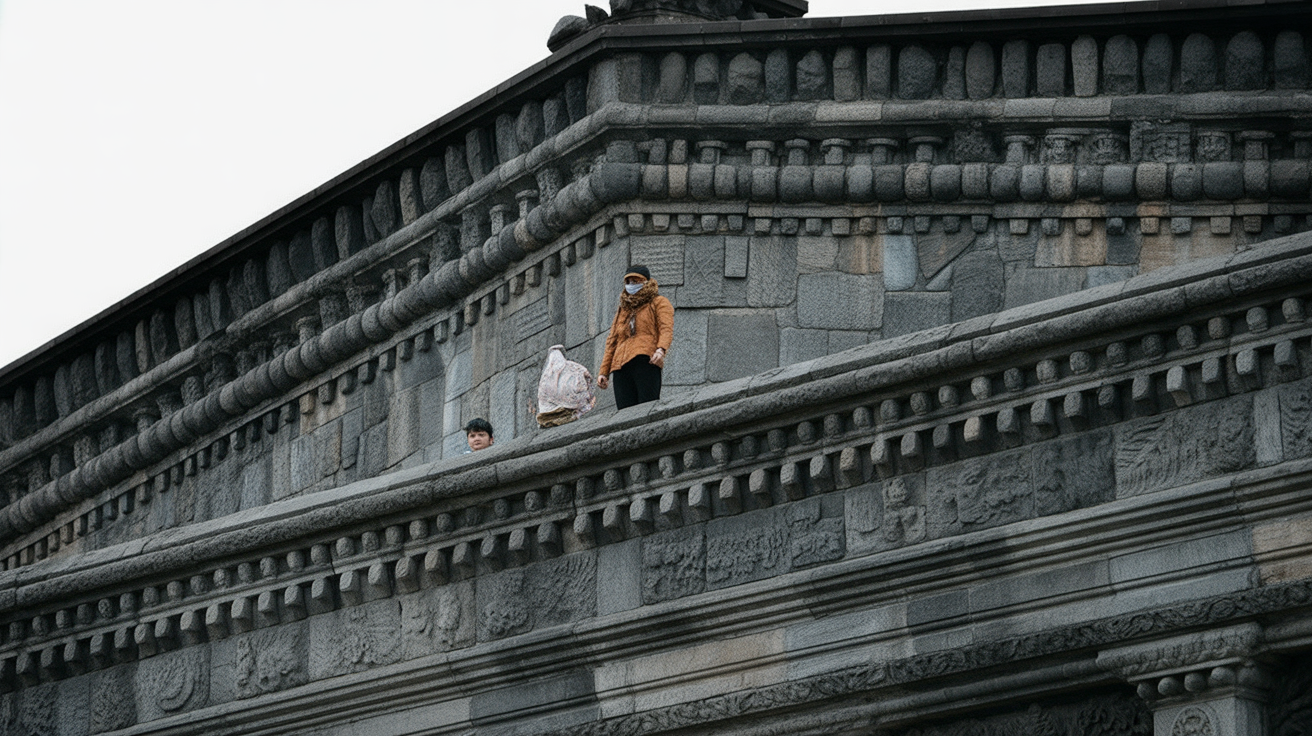
The site is an exposed plateau above the gorge — no shade at the temple itself. In June–September, midday temperatures here hit 30–35°C and the stone radiates heat. Go in the morning. The view from the southeast corner of the promontory — looking down into the gorge where the Azat River is a specific shade of green-blue — is the best view at the site and requires walking to the edge of the platform.
GPS: 40.1120° N, 44.7270° E.
Allow 45 minutes to an hour at Garni. The temple itself takes 20 minutes to walk around properly. The promontory, the views, and the small museum in the site buildings take another 20–30 minutes. There’s a café at the entrance selling coffee and lavash (Armenian flatbread) — fine, not exceptional.
•BEN’S PICK
Walk past the temple to the southeast corner of the promontory — past the small church ruin, toward the gorge edge. The view here is the one that makes sense of the site’s location: a triangular spur of rock dropping 300 metres to the river on three sides. The Armenians didn’t build here by accident. This was the most defensible position in the valley. Then they built a temple to the sun at the most sun-exposed point of that position. The geography teacher in me finds this very satisfying.
Symphony of Stones: Don’t Skip It
The basalt columns are visible from the road between Garni and Geghard, about 2km past the temple. Most organised tours include a stop here; if you’re making your own way, watch for the car park on the left side of the road as the valley narrows.
The canyon overlook gives the best view — free, no fence, watch your footing. The path down to the river takes 10–15 minutes. The river section gives you a close look at the columns from below and is cooler in summer because of the shade and the water. Both viewpoints are worth the time, though if you’re tight on schedule, the overlook is the essential one.
The geometry is genuinely extraordinary — the regular hexagonal columns exist because basalt contracts as it cools, forming the most efficient possible packing geometry. The same formation mechanism creates similar structures worldwide (Giants’ Causeway, Fingal’s Cave, the Svartifoss waterfall in Iceland). The Armenian version is less famous than all of these and significantly less visited. On a weekday morning, you may have the overlook entirely to yourself.
Geghard Monastery: The Main Event
Geghard is 9km past Garni on the same road, which ends at the monastery. There’s no further destination — you drive to the end of the gorge and this is what’s there. The setting increases in drama the further you go: the valley narrows, the cliffs get higher, the river disappears and then reappears, and then the monastery appears carved into the cliff face above a series of stone terraces.
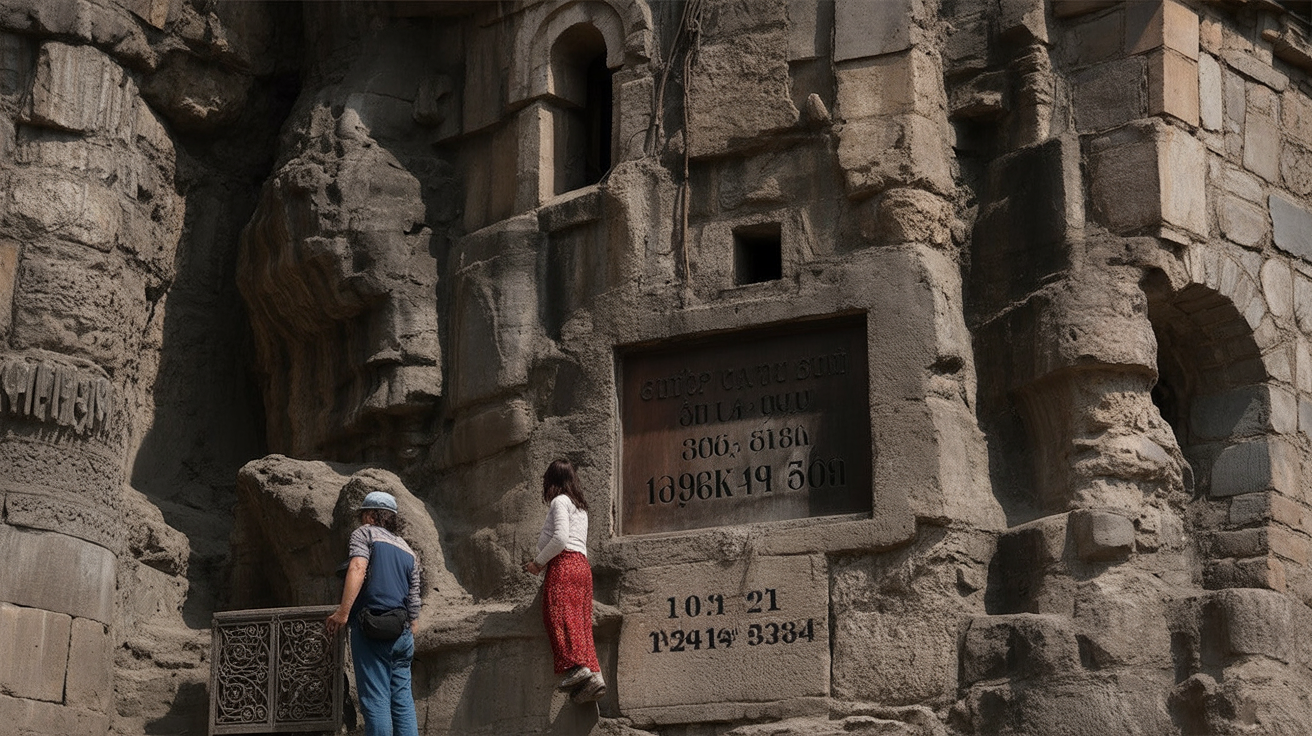
Entry is free. It is an active monastery — services take place, monks are present, candles burn in the rock-cut chapels. Dress code: women cover their heads inside the main cathedral and chapels (scarves available at the entrance). Remove shoes before entering the carved chambers.
GPS: 40.1326° N, 44.8166° E.
The site has two main carved areas beyond the main cathedral. The gavit (narthex) is carved from the cliff, with a central oculus (round opening in the ceiling) that creates a shaft of light into the stone interior. The inner chamber (Astvatsatsin Chapel) is deeper into the rock — smaller, darker, with a khachkar (Armenian cross-stone) carved into the cliff wall and stalactite ornamentation on the vaulted ceiling. The acoustics in this chamber are the most significant thing about it.
If there’s no one singing, try speaking in a normal voice and listen to what the stone does to the sound. If there is someone singing — a monk, a visiting choir, an Armenian grandmother who knows what the room can do — stay as long as is reasonable. The rock-hewn interior amplifies and sustains sound in a way that feels engineered. It was. The 13th-century architects who built this understood what the rock would do and designed accordingly.
⚠Real Talk
Geghard is an active place of worship, not a museum. If you arrive during a service, wait at the outer terrace or visit the main cathedral first and come back to the inner chambers afterward. Treat it the way you’d treat a working church anywhere — with the respect due to the people using it, not just the building containing them. Most visitors get this right. Occasionally someone doesn’t, and it makes the site worse for everyone else.
The History That Makes These Sites Matter
The geography teacher in me won’t let this article exist without two minutes of context, because Garni and Geghard without context are just old buildings, and old buildings are everywhere. With context, they’re the same 10km stretch of gorge used for 3,000 years of continuous settlement, worship, and survival.
Armenia is the oldest Christian nation on earth — the Kingdom of Armenia officially adopted Christianity in 301 AD, roughly two decades before the Roman Empire. Garni Temple predates that conversion by 300 years, built in the 1st century AD during the period when Armenia was navigating a delicate balance between Rome and the Parthian Empire. King Tiridates I built Garni as part of a broader project of cultural prestige — the temple style is Hellenistic (Roman-influenced), the dedication is to an Armenian sun god, and the location above the gorge is a statement of power. This is a king building in a language other empires could read.
When Armenia converted to Christianity in 301 AD under King Tiridates III, the conversion was comprehensive — pagan temples were destroyed throughout the kingdom. Garni survived because the same family that ordered the Christian conversion used the temple as a summer palace. The architectural form was retained; the religious function was ended. The earthquake of 1679 collapsed it. The Soviet-era reconstruction in 1969–1975 restored it from original stone, using photographic records and surviving stone fragments. This is the structure you see now.
Geghard was founded in the 4th century, shortly after the Christianisation. The current monastery buildings date from the 13th century, during the kingdom of the Zakarian dynasty — the same period that produced much of the surviving Armenian medieval architecture. The site was chosen for the same reasons the gorge was always chosen: defensible, water-accessible, and isolated enough from the main road to be safe from casual raid. The Holy Lance — the spear that supposedly pierced Christ’s side — was kept here from the 3rd century until it was moved to Etchmiadzin. The monastery became a major pilgrimage centre precisely because of the relic. Pilgrims still come. They look like the pilgrims who came in the 13th century: older women with candles, serious young men with intentions, the occasional monk moving through the outer courtyards without acknowledging the tourists.
This context changes what you see when you walk between the sites. The 10km road from Garni to Geghard is not just a scenic drive. It’s a timeline: pagan Armenia, Christian Armenia, medieval Armenia, Soviet reconstruction, 21st-century pilgrimage. The gorge held all of it and is still holding it.
Getting There from Yerevan
Three options, in order of independence:
Marshrutka (most local): From Gai Bus Station (Կայ ավտոկայան) on Admiral Isakov Avenue in Yerevan — take minibus route 266 toward Garni. Cost: 250 AMD (~£0.48 / ~$0.63). The marshrutka runs to Garni village, from where a short walk or local taxi takes you to the temple. Getting from Garni village to Geghard requires another taxi or hitching a lift (common — the road dead-ends at the monastery, so anyone going is going there). Allow time and flexibility; the marshrutka schedule is “when full” rather than fixed times.
Taxi from Yerevan: A round-trip taxi covering all three sites (Garni, Symphony of Stones, Geghard) runs approximately 10,000–15,000 AMD (~£19–28.50 / ~$25–37.50) negotiated in advance. If you take a taxi to Garni one-way: 4,000–6,000 AMD (~£7.60–11.40). The taxi option gives you control over how long you spend at each site. Negotiate the total price and itinerary before you get in.
Organised tour from Yerevan: Group tours covering Garni, Symphony of Stones, and Geghard typically run $20–44 per person for a shared group tour, more for private options. Tours usually depart mid-morning and return by early afternoon. Most include Garni entry, transport, and a guide. Lunch and Geghard entry (which is free) are separate. If you want someone to handle the context — what you’re looking at and why it matters — a tour guide at Garni specifically is worth the extra cost.
How Long Do You Need
Half a day is enough for the essentials — arriving by 9–10am and leaving by 1–2pm covers all three sites at a reasonable pace. A full day (arriving 9am, leaving 4–5pm) allows you to slow down, eat lunch in Garni village, and spend more time at Geghard without feeling rushed.
The sites are all within 10km of each other and the drive between them is part of the experience — the gorge changes character as you go deeper. Don’t rush the road.
The Confession: What I Got Wrong About Timing
I arrived at Geghard at noon on a Sunday in June. I’d timed it wrong for two reasons: noon is the hottest part of the day on an exposed approach (the final 300 metres to the monastery entrance is in direct sun), and Sunday is when family gatherings happen, which on that particular Sunday meant a wedding ceremony in the main cathedral that would occupy the central space for another hour at least.
I sat outside on the stone terrace above the gorge and waited. This turned out to be the correct outcome, if not the planned one. A monk walked through the terrace below me, chanting something in Armenian that I couldn’t identify, and the sound of it hit the cliff face behind the monastery and came back as an echo that was not quite identical to the original. I sat there for 40 minutes listening to this happen at intervals. It was better than what I’d planned.
If you arrive at Geghard and there’s a service or ceremony: wait outside on the terrace. The gorge setting and the sound that moves through it are reasons to be there regardless of what’s happening inside. The 13th-century builders chose this specific place for specific reasons, and those reasons are still audible.
FAQ: Garni Temple and Geghard Monastery
- Can you visit Garni and Geghard in one day from Yerevan?
- Yes, easily — all three sites (Garni Temple, Symphony of Stones, Geghard Monastery) are within 37km of Yerevan and can be covered in a half-day. Arriving at 9am and returning to Yerevan by 2–3pm is achievable without rushing. A full day gives you more time at each site, a proper lunch stop in Garni village, and the option to return to Geghard in the late afternoon when the light in the gorge changes.
- How do I get to Garni and Geghard from Yerevan without a tour?
- Take marshrutka route 266 from Gai Bus Station in Yerevan to Garni village for 250 AMD (~£0.48). From Garni village to the temple is a short walk or 500–1,000 AMD taxi. From Garni to Geghard requires a separate taxi (2,000–3,000 AMD) or a lift — the road dead-ends at the monastery so anyone driving there is going there. The independent option takes more time but gives you flexibility on pacing.
- Is Geghard Monastery free to enter?
- Yes — Geghard is a working monastery and entry is free. Garni Temple charges 1,500 AMD (~£2.85 / ~$3.75) for foreign visitors. The Symphony of Stones is free. Total paid entry for the day trip is 1,500 AMD — one of the best-value heritage day trips in the Caucasus given what you’re seeing.
- What is the Symphony of Stones in Armenia?
- Hexagonal basalt columns in the Azat River Gorge between Garni and Geghard, formed when ancient lava flows cooled and contracted. The geometry (regular hexagons) is the most efficient packing arrangement for the contraction — the same process creates the Giant’s Causeway in Northern Ireland and Fingal’s Cave in Scotland. The Armenian formation is less famous and far less visited, visible from the road and accessible by a short descent to the river.
- What is Garni Temple and why is it significant?
- Garni Temple is the only surviving pre-Christian Hellenistic temple in the Caucasus — built in the 1st century AD by Armenian King Tiridates I and dedicated to the sun god Mihr. Armenia adopted Christianity in 301 AD (the first nation-state to do so), but Garni survived because later kings used it as a summer residence rather than demolishing it. The 1679 earthquake destroyed it; the current structure was reconstructed in the 1970s from original stones. Entry: 1,500 AMD (~£2.85).
- What is the best time to visit Garni and Geghard?
- Spring (April–June) and autumn (September–October) are the best windows — comfortable temperatures, green gorge, clear mountain views. Summer (July–August) is hot at Garni’s exposed plateau but the gorge at Geghard is cooler. Winter brings snow to the approach roads and can make driving hazardous — one traveller review specifically warns “slippery dangerous” winter road conditions. Go in the morning regardless of season: both sites are better before midday, and Geghard specifically is better before tour groups arrive.
What to Eat Near Garni: The Practical Guide
Most guides skip the food section for Garni and Geghard. This is a mistake, because Garni village has one of the better lunch options available on any day trip from Yerevan — and eating after the monastery visit, in the shade of the gorge, is significantly better than eating a rushed lunch back in the city.
Garni village restaurants: Several small restaurants cluster around the main approach to the temple site. The format is Armenian BBQ (khorovats) with lavash, vegetables, and matsun (Armenian yoghurt). Budget 3,000–5,000 AMD per person (~£6–10). The quality is roughly equivalent across venues — look for a restaurant that’s actually busy with local families rather than exclusively tourists. Weekend lunchtimes at Garni have a specific character: families from Yerevan who’ve made the same trip, three generations eating khorovats while the children run between the outdoor tables. This is the correct setting for a post-temple lunch.
Geghard monastery café: There’s a small café at the entrance to Geghard selling coffee, tea, and lavash. Fine for a coffee before entering. Not a meal stop. The monastery vendors outside sell churchkhela (walnut-grape candy) and dried fruits — buy a bag of the dried apricots if you see them. Armenian dried apricots are a different thing from the supermarket variety. Worth 500–1,000 AMD.
Practical logistics: If you’re doing the full circuit (Garni → Symphony of Stones → Geghard → lunch → return), build the lunch stop into Garni on the way back rather than Geghard. You’ll be returning through Garni village anyway, and the restaurant options are there rather than at the monastery.
Before You Go
This is the day trip from Yerevan that makes the most clear case for Armenia as a destination in its own right — not just a transit between Georgia and the rest of the Caucasus. The geography teacher in me needs you to understand: a Hellenistic pagan temple built in the 1st century, the oldest Christian nation on earth adopting that religion 300 years later, a 13th-century monastery carved into a basalt cliff above a river gorge — these are not separate facts. They’re a single continuous story visible in the landscape within a 10km stretch of road.
Take the time. Go in the morning. Wait if there’s a service at Geghard. Listen to what the stone does to sound.